
Market Watch

Updated Friday, October 23, 2026 · Today's market news in short briefs — every story opens to its full brief right here on this page, plus the events to watch this week, with dates, times and what to expect.

Today's top story

AI selloff meets oil shock: Nasdaq's worst day since June as Brent hits a five-month high

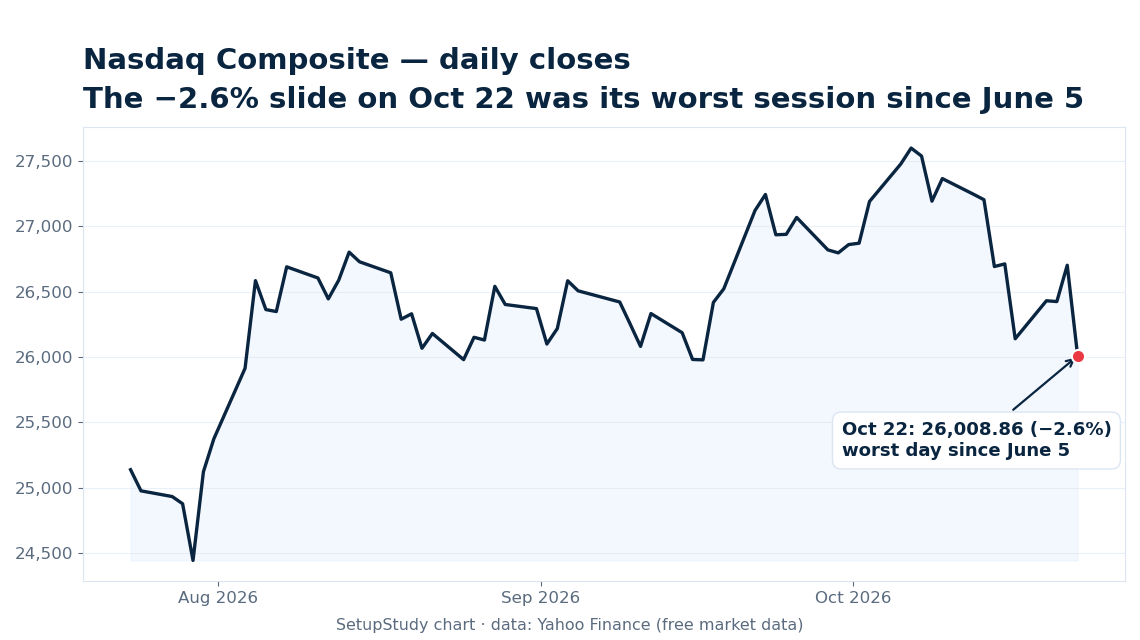
The Nasdaq fell 2.6% to 26,008.86 on Thursday — its worst session since June — as chip stocks cratered 6.7% and Meta's capital-spending warning fed fears about who pays for the AI buildout. Brent crude jumped 4% to $113.17, a five-month high, after reports that the US and Israel drew up plans for strikes on Iran, while Treasury yields plunged as money fled to bonds. Beginner takeaway: the market's worry flipped from "will AI earn enough?" to "who pays for the AI buildout?" — and an oil spike into an FOMC week is the wildcard that complicates the Fed's call.

Read the full brief

Thursday was a textbook risk-off day. The Nasdaq Composite closed down 2.6% at 26,008.86 — its worst single day since June — while the Nasdaq 100 fell 2.9% and the Philadelphia Semiconductor Index lost 6.7%, its biggest drop since June 23 (Reuters). The S&P 500 fell 1.2% to 7,663.43, but the Dow barely moved — up 0.02% to 52,867.98 — and the Russell 2000 edged up 0.1%. The pain was concentrated in tech: consumer staples rose 3.1% and utilities 2% as defensive names took the rotation.

The trigger was Meta's Q3 report: revenue beat at $64.6 billion (+26% y/y), but capital spending guidance went up, operating cash flow lagged it, free cash flow turned negative, and the company disclosed roughly $825 billion in future lease and contract commitments. "Investors can't find a satisfactory level of AI capex," KCM Trade's Tim Waterer told Bloomberg: more spending fuels financing worries, less fuels growth worries. Lam Research's warning of supply-chain constraints into 2027 and Nvidia CEO Jensen Huang's remark that neoclouds "lack the working capital to fund growth" piled on, and Daishin Securities' Lee Kyoung-min told Korea JoongAng Daily that AI credit-risk concerns are now limiting any rebound in chip shares.

Bonds rallied hard on the fear trade: the 10-year Treasury yield fell about 17 basis points to 4.96% (US Treasury daily par yield) — its sharpest drop in over a year — after sitting at 5.36% just last week. Vital Knowledge noted the 10-year would likely be below 4.5% without the oil shock and the Iran war premium.

The oil shock: Brent settled up 4% at $113.17 and WTI up 2.4% at $99.47 — five-month highs — after the New York Times reported, citing unnamed US officials, that Washington and Tel Aviv have drawn up specific plans for a "short but intensive" operation against Iran's energy, nuclear and missile sites after the Nov 3 midterms. Trump has not approved any operation. The US ordered non-emergency diplomats and families out of Saudi Arabia as Houthi attacks hit an airport in Dammam and an Aramco oil field.

Beginner takeaway: when fear rises, money leaves tech stocks for bonds — that's the fear trade, and it shows up as yields plunging while Nasdaq falls. An oil spike into an FOMC week is the wildcard: higher oil can push inflation up, which is exactly what makes the Fed's decision harder next week. This explains what happened; it is not a prediction of what happens next.

Sources: Reuters, Bloomberg (KCM Trade's Tim Waterer), New York Times, US Treasury daily rates, Finnhub · Oct 22–23
Sources: Reuters, Bloomberg, NYT · Oct 22–23 NASDAQ −2.6% SOX −6.7% BRENT +4% 10Y −17 bps
SetupStudy chart: Nasdaq Composite daily closes showing the October 22, 2026 drop of 2.6%, its worst day since June

Our chart · data: Yahoo Finance (free market data)

Market news by category

Short briefs from Thursday's session (Oct 22) and overnight. Each brief is complete right here — no link-outs. Original wording; figures checked against reporting.

Top Stories

Shutdown reaches day 22 — but jobless claims still printed

The US government shutdown entered day 22 on Thursday, with the Senate failing another budget bill and the White House warning the October jobs report and CPI may never be published. Yet weekly jobless claims came in at 194,000 vs 200,000 expected — a three-month low — showing some Labor Department data is still flowing.

Read the full brief

The October 1 shutdown has suspended BLS releases — the September jobs report (due Oct 3) is delayed, the September CPI suspended — and the White House warned Wednesday the October jobs report and CPI may never be published. The Fed meets Oct 27-28 with only partial official data.

The surprise bright spot: weekly jobless claims printed at 194,000, below the 200,000 expected and a three-month low (US Labor Department, via Investing.com market reporting) — a signal that some Labor Department data collection is still running despite the shutdown. Markets also flagged that USDA warned SNAP food aid funding runs out in November, affecting about 42 million people.

Beginner takeaway: markets hate a data blackout — when the official numbers go dark, every private indicator (PMI surveys, jobless claims, Michigan sentiment) carries extra weight. That's why today's flash PMI readings matter more than usual.

Sources: US Labor Dept (via Investing.com), Reuters · Oct 22–23
Sources: Labor Dept, Reuters · Oct 22–23CLAIMS 194k

US and Israel draw up Iran strike plans; US pulls diplomats from Saudi Arabia

The New York Times reported, citing unnamed US officials, that Washington and Tel Aviv have specific plans for a "short but intensive" operation against Iran's energy, nuclear and missile sites after the Nov 3 midterms. The US ordered non-emergency diplomats and families out of Saudi Arabia as Houthi drones hit a Dammam airport and an Aramco field.

Read the full brief

According to the New York Times' reporting, the plans target energy, nuclear and missile sites, but President Trump has not approved any operation. Defense Secretary Hegseth met Netanyahu unannounced this week, and Trump said the US is "not negotiating" with Iran and that something could come "fairly soon."

The regional escalation is visible: Houthi strikes hit an airport in Dammam (one killed, eight injured) and the Aramco Shaybah oil field; Reuters reported family withdrawals are being considered for other regional missions, and NBC reported some US military personnel are to leave bases in Jordan, Kuwait and Qatar. The Wall Street Journal reported Iran's floating oil reserves in Asia have run dry under the US naval blockade. Saudi Arabia says oil operations are unaffected.

Markets priced the risk instantly: Brent +4% to $113.17, WTI +2.4% to $99.47 — five-month highs — before any physical disruption.

Beginner takeaway: oil is geopolitics-priced — futures markets price in the risk to supply routes before anything physical happens. That premium can unwind just as fast if tensions cool.

Sources: New York Times, Reuters, CNBC/NBC, WSJ · Oct 22–23
Sources: NYT, Reuters, NBC · Oct 22–23BRENT +4%WTI +2.4%

Moderna crashes 17.6% after its cancer-vaccine data disappoints

Moderna fell 17.6% to $202.63 after late-stage data for its personalized melanoma vaccine intismeran (with Merck's Keytruda) showed a 42% cut in recurrence-or-death risk — below the 49% seen in an earlier trial, read as a letdown. Full data lands at the Oct 24 ESMO conference.

Read the full brief

The headline numbers were strong in isolation: intismeran plus Keytruda cut recurrence-or-death risk by 42% versus Keytruda alone. But the earlier trial had shown 49%, and after a 500%+ rally in the stock, expectations were set at the higher bar — the apparent early leak of the data (reported by Motley Fool and market outlets) triggered a classic sell-the-news unwind. Merck slipped about 1%.

The full dataset is due at the ESMO cancer conference on Oct 24, so Thursday's move was based on leaked top-line numbers, not the complete picture.

Beginner takeaway: in biotech, stocks trade on expectations vs. the number — a good headline can still be "not good enough" if the bar was set higher. Expectation is the denominator.

Sources: Reuters, Investing.com/Motley Fool · Oct 22–23
Sources: Reuters, Investing.com · Oct 22MRNA −17.6%

Markets & Economy

Treasury yields post their sharpest drop in over a year

The 10-year Treasury yield fell about 17 basis points to 4.96% (daily par yield) — its biggest one-day drop in more than a year — as investors fled tech stocks for bonds. The 10-year had hit 5.36% just last week.

Read the full brief

The move was a straight flight to safety: as the Nasdaq lost 2.6% and chip stocks cratered, bond prices surged and yields collapsed. The 10-year sat at 5.36% only a week earlier — Thursday's drop erased a chunk of that climb in one session.

Analyst notes add context: Vital Knowledge reckons the 10-year would likely be below 4.5% without the oil shock and the Iran war premium — meaning part of the yield is geopolitical insurance, not growth. Fed-funds futures now imply roughly an 89% chance the Fed holds on Oct 28 (via Investing.com market reporting), with about 94% priced for one more hike by the December meeting.

Beginner takeaway: yields and stock prices often move in opposite directions on fear days — bonds are the shelter, so when bond prices rise, their yields fall. A plunging yield is the market voting "scared," not "happy."

Sources: US Treasury daily rates, Vital Knowledge, Investing.com · Oct 22
Sources: US Treasury, Investing.com · Oct 2210Y YIELD −17 bps

Gold falls even as the bond rally should have helped it

Spot gold fell about 1.7% to roughly $4,039 — despite collapsing yields, normally a tailwind for the metal — as investors appeared to raise cash. Silver dropped harder, about 5.9% to $54.55.

Read the full brief

It was an odd decoupling: falling yields usually support gold, but Thursday's violence sent everything into the "sell to raise cash" bucket. The SPDR Gold Shares ETF (GLD) fell 2.6%, and Bitcoin — down 3.3% to about $81,244 — offered no safe-haven bid either.

Longer-term bulls are unmoved: BlackRock's Hambro sees gold rising on government debt and deficits, and Rieder sees a historic opportunity in high-grade bonds (both via Investing.com market reporting).

Beginner takeaway: gold is a haven, but on violent risk-off days everything gets sold to raise cash first — correlations go to one. The haven bid and the panic bid are two different things.

Sources: spot market data via Investing.com, Finnhub · Oct 22–23
Sources: Investing.com, Finnhub · Oct 22GOLD −1.7%

Yen and franc lead as the haven trade returns

The dollar slipped against safe-haven currencies Thursday: USD/JPY fell toward 158 and the dollar/Swiss franc lost about 0.5% as the Treasury rally supported havens. The euro slipped 0.2% to 1.1213, weighed by French bond stress.

Read the full brief

The pattern was textbook carry-trade unwind: when global fear spikes, investors buy back the funding currencies they borrowed — the yen and the Swiss franc. USD/JPY traded around 158.1–158.2 (Reuters), and with the Bank of Japan meeting Oct 29-30, that level keeps intervention risk alive.

The euro was the odd one out among majors, slipping 0.2% to 1.1213: France's 10-year yield pushed above 5% on Oct 21 — its highest since 2002 — with the spread over German Bunds near 160 basis points, the widest since the 2012 euro-area debt crisis.

Beginner takeaway: in risk-off, the "funding currencies" (yen, franc) tend to rally as carry trades unwind — people buy back what they borrowed. Currency moves are the same fear trade, expressed in FX.

Sources: Reuters, Investing.com · Oct 22
Sources: Reuters, Investing.com · Oct 22USD/JPY ~158

France's bond stress is doing the ECB's tightening for it

France's 10-year yield pushed above 5% on Oct 21 — its highest since 2002 — leaving the spread over German Bunds at about 160 basis points, near the widest since the 2012 euro-area debt crisis, days before the ECB's October 29 decision.

Read the full brief

France's borrowing costs are climbing on their own, driven by fiscal worries — and that is tightening financial conditions across the euro area without the ECB lifting a finger. ING's Carsten Brzeski wrote that the stress is "eroding the need for additional rate hikes" from Frankfurt.

The consensus is a hold at the 2.50% deposit rate on Oct 29 (via Investing.com market reporting), with markets parsing Christine Lagarde's press conference for a December signal.

Beginner takeaway: when a country's borrowing costs rise on their own, its central bank can do less — the market tightens for them. Bond-market stress is monetary policy by other means.

Sources: Investing.com, ING (Carsten Brzeski) · Oct 21–23
Sources: Investing.com, ING · Oct 21FR-DE 10Y ~160 bps

Crypto

Bitcoin slides 3.3% as the AI-scare selloff spreads to crypto

Bitcoin fell 3.3% to about $81,244 — its worst drop in two weeks — as the risk-off mood from the Nasdaq selloff hit crypto. Ether dropped 3.6% to around $2,440; Solana lost 3.3%.

Read the full brief

The move tracked equities almost tick for tick: crypto offered no haven bid on Thursday, falling in line with the Nasdaq's 2.6% slide. The irony is that spot bitcoin ETFs had taken in over $1 billion in the week's first three days (SoSoValue, via Motley Fool/Investing.com) — fresh inflows that met a risk-off wall.

Crypto-linked equities fell in line: the iShares Bitcoin Trust and Fidelity's bitcoin fund each dropped about 3.7%, and the iShares Ethereum Trust fell 4.5%.

Beginner takeaway: crypto trades like high-beta tech — on risk-off days it falls with the Nasdaq, not apart from it. The "digital gold" story is for the long term; the short term is risk-on/risk-off.

Sources: Motley Fool/Investing.com, CoinDesk, Finnhub · Oct 22–23
Sources: Investing.com, CoinDesk · Oct 22BTC −3.3%

Altcoins take the harder hit: XRP −6.4%, DeFi index −5.6%

XRP sank 6.4% to $1.30 and CoinDesk's DeFi index slumped 5.6%, outpacing bitcoin's fall, as altcoins bore the brunt of the risk-off session.

Read the full brief

Within crypto itself there was a second rotation: money moved toward relative safety (bitcoin) and out of the riskier tail (altcoins, DeFi tokens). XRP's 6.4% slide to $1.30 and the DeFi index's 5.6% drop both roughly doubled bitcoin's 3.3% fall.

Beginner takeaway: in a selloff, liquidity leaves the riskiest assets first — large caps fall less, small caps and DeFi tokens fall more. Risk is layered: crypto vs. stocks is one layer, bitcoin vs. alts is another.

Sources: Motley Fool/Investing.com, CoinDesk · Oct 22
Sources: Investing.com, CoinDesk · Oct 22XRP −6.4%

OpenAI said to near $30B round at a $1.25T valuation

CNBC reported after the bell that OpenAI is nearing a funding round of up to $30 billion at a $1.25 trillion valuation, led by investors from the UAE — even as public AI stocks sold off on capex fears.

Read the full brief

The contrast is the story: on the same day public markets punished Meta and chip stocks for AI spending, private markets were reportedly valuing the leading AI lab at $1.25 trillion (CNBC, after the bell Thursday). Relatedly, Musk disclosed a roughly $1 billion investment in Skydance, and JPMorgan doubled its SpaceX price target to $500 on AI growth.

Beginner takeaway: public and private markets can disagree wildly on the same theme — public stocks price today's cash flows, private rounds price tomorrow's story. The gap between them is where the argument lives.

Sources: CNBC, Investing.com · Oct 22
Sources: CNBC, Investing.com · Oct 22OPENAI $1.25T

Earnings

Meta −7%: a revenue beat the market sold anyway

Meta fell 7% to $648.85 despite Q3 revenue of $64.6 billion (+26% y/y): it raised capital-spending guidance, disclosed roughly $825 billion in future lease and contract commitments, posted negative free cash flow, and plans a new non-voting share class — effectively a 2-for-1 split.

Read the full brief

The quarter itself was fine: revenue up 26%, and the 2-for-1-style split via a new non-voting share class is mechanically neutral. What the market hated was the outlook — capex guidance raised, operating cash flow outpaced by spending, free cash flow at -$2.12 billion, and GAAP EPS of $3.83 weighed down by a $9.9 billion legal charge (via TipRanks/Investing.com market reporting).

Meta alone set the tone for the session: its 7% drop was the single biggest weight on the Nasdaq and the S&P 500, and it gave every other AI spender's report a harsher read.

Beginner takeaway: stocks trade on the future, not the past — a great quarter with a scary spending outlook can still get punished. Guidance is the report; the quarter is history.

Sources: TipRanks, Investing.com, Yahoo Finance · Oct 22
Sources: TipRanks, Investing.com · Oct 22META −7%

Lam Research −11.8% on supply-chain warning into 2027

Lam Research fell 11.8% to $230.15 after narrowly beating fiscal Q1 estimates but warning of supply-chain and clean-room constraints into 2027 — too little for investors pricing lofty AI expectations. Nvidia fell 4.4% in sympathy.

Read the full brief

The chip-equipment maker beat the quarter but the outlook disappointed: supply-chain and clean-room constraints stretching into 2027 mean AI chip capacity can't ramp as fast as the market's models assume. The Philadelphia Semiconductor Index fell 6.7% on the day, its worst since June 23 (Reuters).

Nvidia fell 4.4% to $212.21, not helped by CEO Jensen Huang's remark that neoclouds "lack the working capital to fund growth" — a comment that fed the session's financing-anxiety theme.

Beginner takeaway: in a hot theme, guidance matters more than the quarter — the bar for "good enough" rises with the stock price. When everyone expects perfection, merely good is bad.

Sources: Yahoo Finance, Reuters, Investing.com · Oct 22
Sources: Yahoo Finance, Reuters · Oct 22LRCX −11.8%NVDA −4.4%

Spotify +11%, Blackstone +8.4%, P&G +5.6%, Lockheed +7%: the other side of earnings

Spotify jumped 11% to $583.66 on better margins; Blackstone rose 8.4% on Q3 results; P&G gained 5.6% on an EPS and revenue beat with raised sales guidance; Lockheed climbed 7% on a record $292 billion backlog and raised full-year guidance.

Read the full brief

While tech burned, cash-flow names got rewarded. Lockheed's quarter was the standout: EPS of $7.97 vs $7.52 expected, revenue $20.7 billion, a record $292 billion backlog (+27% quarter-on-quarter), full-year revenue guidance raised to $80–82 billion, and a 10-year F-35 framework covering 850 jets (Morningstar/Dow Jones). Blackstone rose 8.4% to $118.75 on its Q3 report; P&G gained 5.6% to $165.59 on beats and raised sales guidance; Spotify's 11% pop to $583.66 came on improved margins and 788 million monthly active users (+11% y/y).

This is the rotation the day's sector numbers show: staples +3.1%, utilities +2%, financials +1.2% — money didn't leave the market, it moved.

Beginner takeaway: in a risk-off market, companies with real cash flows and backlogs get rewarded — "show me the money" stocks. Rotation is not the same as a crash: watch where the money goes, not just where it leaves.

Sources: Morningstar/Dow Jones, Investing.com, TipRanks, CoinDesk · Oct 22
Sources: Morningstar, Investing.com · Oct 22SPOT +11%BX +8.4%

Tesla −3.1% despite a beat — Musk's capex caution

Tesla fell 3.1% even after beating expectations, as Musk's cautious capital-spending commentary clashed with the day's anti-spending mood. Ex-director Steve Westly told CNBC Musk must expand self-driving and robotics to justify the valuation.

Read the full brief

Tesla shows the day's logic from the other side: the AI-capex anxiety cut both ways — spenders (Meta) got hit for spending, and Tesla got hit despite caution, because the theme of the day was fear itself. Westly's CNBC comment sets the bar for the next chapter: the valuation needs self-driving and robotics to become real businesses, not promises.

Beginner takeaway: when the market's theme is fear, even good news gets sold — sentiment is the tide, and it lifts or sinks every boat. Trade the theme, not just the ticker.

Sources: Reuters, CNBC · Oct 22
Sources: Reuters, CNBC · Oct 22TSLA −3.1%
SetupStudy Take

The AI-spending trap: why good earnings can still sink a stock

Thursday's selloff had a clean logic. AI growth needs capital spending. Capital spending needs financing — and financing risks margins, cash flow and balance sheets. So the market demands two contradictory things at once: spend enough to grow, but not so much that the bill scares us. KCM Trade's Tim Waterer put it to Bloomberg: "Investors can't find a satisfactory level of AI capex" — more spending fuels financing worries, less fuels growth worries.

Posted by Admin

Read the full brief

This is a trap, not a verdict on AI. Meta grew revenue 26% — the business is fine; the fear is the $825 billion in future commitments and negative free cash flow. Lam beat the quarter — the fear is that clean-room constraints into 2027 cap the whole industry's growth. Nvidia's Huang added the financing angle: neoclouds "lack the working capital to fund growth," meaning even willing spenders may not be able to pay.

What actually resolves a trap like this is time and cash: either the spending turns into revenue (then the capex looks smart), or it doesn't (then it was a bubble). Earnings seasons are the checkpoints — that's why guidance now moves stocks more than the reported quarter.

Beginner takeaway: earnings season isn't a quiz with one right answer — the same number can be good or bad depending on what the market was afraid of that day. Learn to ask "what was the fear?" before "was the number good?" This is an explainer, not a prediction — it describes the mechanism, not what happens next.

SetupStudy original explainer · data from the Oct 22 session briefs above
Education only. SetupStudy teaches how markets work. Nothing here is financial advice, a signal, or a promise of profit. Trading involves risk — never trade money you can't afford to lose. Read the full disclaimer →